
Zephyra Dynamics
The fundamentals of urban air mobility and where India stands
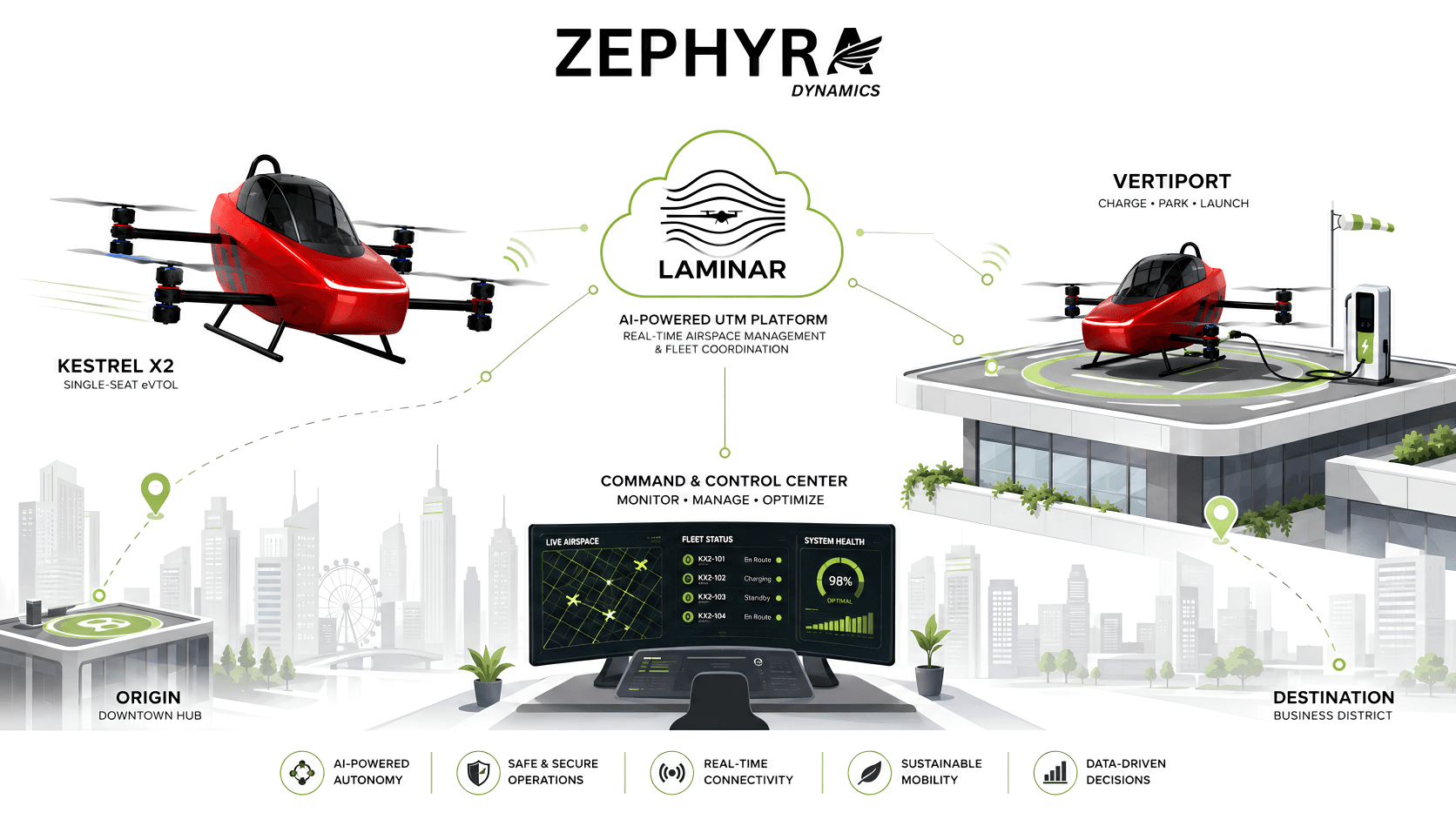
A practical look at the aircraft, airspace systems and regulatory foundations behind urban air mobility in India.
0 likes · 0 comments · 0 shares
Every fast-growing city eventually reaches the same constraint. There is only so much road, and it can only move so many people. Urban Air Mobility, or UAM, uses small electric aircraft that take off and land vertically for short point to point journeys. It exists because urban transport needs another option, not because flying cars sound exciting.
At Zephyra Dynamics, our work focuses on the engineering behind the aircraft and the systems required to operate it safely. That includes redundant propulsion, low noise and airspace conflict management. These are the fundamentals as we see them and the context in which India is developing its own UAM ecosystem.
What makes an eVTOL different from a helicopter
The core technical shift is distributed electric propulsion. Instead of relying on one or two large rotors driven by a single engine, an eVTOL spreads lift across multiple electric motors. This provides additional redundancy and gives designers more freedom to balance the aircraft's performance in hover and forward flight.
Electric propulsion can also reduce operating noise, an important consideration for aircraft intended to work near homes and workplaces. The exact design varies between manufacturers, but the common objective is an aircraft suited to frequent short journeys in and around cities.
The second fundamental is airspace. An aircraft is only useful when there is a safe system for deciding where and when it can fly. UAS Traffic Management, commonly called UTM, supports route planning, conflict detection and coordination for low altitude traffic. Aircraft and airspace software are therefore two connected parts of the same operating system.
India's regulatory foundations
India has begun developing the regulatory structure needed for urban air mobility. The work includes certification pathways for eVTOL aircraft, vertiport design guidance and policy for future passenger operations. This creates a clearer framework for companies moving from research and prototypes toward certifiable aircraft.
India also has experience with Digital Sky, a national framework for drone operations. That experience provides an institutional foundation for managing low altitude aircraft through digital permissions and coordinated traffic services.
Commercial interest is developing alongside regulation. Different teams are pursuing both multiseat and single seat aircraft, while aviation and mobility companies continue to study routes, vertiports and operating models for major cities. The underlying need is clear. Congestion costs commuters time and reduces productivity across growing urban areas.
The global picture
Urban air mobility is developing across several continents and regulatory systems. Aircraft manufacturers are progressing through testing and certification, while early commercial operations are beginning to demonstrate how autonomous passenger flight could work in practice.
India is not the first country to reach these milestones, but it has a meaningful opportunity. Regulatory development is arriving alongside stronger domestic aerospace capability, in a market where congestion makes the need for new transport options especially clear.
This is the environment Zephyra Dynamics is building for. It is also why we are developing both the aircraft and the airspace platform that supports it.